

Anxiety Before Thought
What the nervous system is doing long before we can name it

Anxiety as a body prediction
When people come to me with anxiety, they usually arrive through their mind first. They tell me about the thoughts — the looping, the anticipating, the rehearsing. And that makes sense. Thoughts are articulate. They’re easy to point to.
What I see, again and again, is that the nervous system has usually shifted before language ever arrives. The body leans forward. Tone increases. Sensory processing narrows. Breathing changes shape. Attention becomes more watchful. By the time anxiety becomes something you can describe, your system has already reorganized itself.
One of the most useful lenses I’ve found for understanding this is predictive processing. Your brain is constantly predicting what will happen next, then updating those predictions based on incoming sensory information. From this perspective, anxiety isn’t just worry. It’s a state where the system is running threat-weighted predictions and keeping the body ready.
Interoception plays a huge role here. That’s your brain’s sensing and interpretation of internal signals — heart rhythm, breath, gut sensation, temperature, muscle tone. When those signals feel intense, unclear, or busy, the brain treats them as meaningful data. It doesn’t pause to reassure itself. It responds. Current research keeps pointing to interoceptive prediction errors — mismatches between what the brain expects and what the body is signaling — as a central mechanism in anxiety.
So if you’ve ever thought, “I know I’m fine, but my body won’t agree,” this is often the gap I’m looking at. Your cortex understands the situation. Subcortical circuits keep running a readiness program because the internal data stream still reads as uncertain. That isn’t irrational. It’s coherence at a deeper level.
If you’re open to a quick check-in here, notice how anxiety shows up for you first. Is it pressure in your thoughts, or is it a posture in your body? Most people have a default. Neither is better. It just tells me where your system announces itself first.
What regulation looks like in real nervous systems
Most of you reading this are already doing somatic practices. That means you’re giving your nervous system different inputs — rhythm, touch, bilateral patterning, breath modulation, sensation anchored in the present moment. What I often see is an expectation that this should produce an immediate internal shift.
In actual physiology, the more common sequence is assessment first, then updating.
This is where people quietly lose trust in the process. You do something gentle and your system doesn’t soften. Sometimes it even feels more activating. And then the assumptions start: I’m doing it wrong. My anxiety is different. This works for other people.
What’s usually happening instead is that your nervous system is finally allowed to notice itself. When attention comes back to sensation, signals that were previously background noise become perceptible. That can feel like an increase, even when what’s really happening is improved access. And when sympathetic charge has been held for a long time, the first signs of movement are often physical rather than emotionally clear — a swallow, a yawn, a sigh, a shiver, a deeper exhale. These aren’t symbolic moments. They’re ordinary autonomic shifts.
There’s also a reason I build integration pauses into this work. A nervous system that’s updating needs time in a lower-demand state to consolidate change. Neuroplasticity is experience-dependent and state-dependent. The system learns best when it isn’t being pushed through the moment it begins to shift.
If I name one piece of updated science that I find genuinely helpful here, it’s vagally mediated heart rate variability. Across large analyses, lower vagally mediated HRV is associated with reduced emotion regulation capacity in anxiety. That doesn’t make HRV a goal or a verdict. It supports something simpler: regulation shows up as physiological flexibility, not as a single feeling you’re supposed to reach.
So when your system begins to settle, notice how it actually feels. For many people, it isn’t calm. It’s space. More room around sensation. More choice with attention. More ability to stay present. A lot of regulation gets missed because people are waiting for calm.
Why the ingredients are not random
I want to name this without turning it into a tutorial. The elements in Day 2 map onto distinct channels of autonomic communication.
Rhythmic bilateral input is interesting because it recruits attention, rhythm, and sensorimotor coordination. In the EMDR literature, bilateral stimulation is still debated mechanistically, but current discussions continue to treat it as meaningful — potentially working through attentional load and changes in how emotionally weighted material is processed. That same principle helps explain why bilateral somatic rhythms can change the texture of anxious rumination for some nervous systems.
Breath with an audible, lengthened exhale matters because breath is one of the few voluntary behaviors with direct, rapid access to autonomic state. Slow, diaphragmatic breathing and practices that emphasize longer exhalation are repeatedly associated with parasympathetic activity and shifts in HRV, alongside reductions in state anxiety in controlled studies and reviews. The specifics vary, and it’s not universal, but the direction is consistent enough to be clinically useful.
Touch and scalp stimulation enter through a different doorway. Mechanoreceptors, cranial and scalp innervation, blood flow changes, and the nervous system’s response to non-threatening tactile input all play a role. Touch is also one of the fastest ways to bring attention out of abstract cognition and back into sensory presence, which matters when anxiety has been running as a future-oriented predictive state.
And the integration pauses are not filler. They’re where the nervous system has space to do what it actually does when it updates — run the new data long enough to decide whether it’s reliable.
If you watch Day 2 with this lens, the routine becomes less about chasing a result and more about tracking how your nervous system assesses, resists, softens, pauses, and reorients in real time. The practices become a way to experience autonomic signaling, not to manage anxiety.
The last check-in I’ll leave you with is a simple one I use myself: after a regulating practice, does your system lean toward stillness, movement, or contact? That preference is often your nervous system telling the truth about what it needs next.
Taking this out of language and into sensation
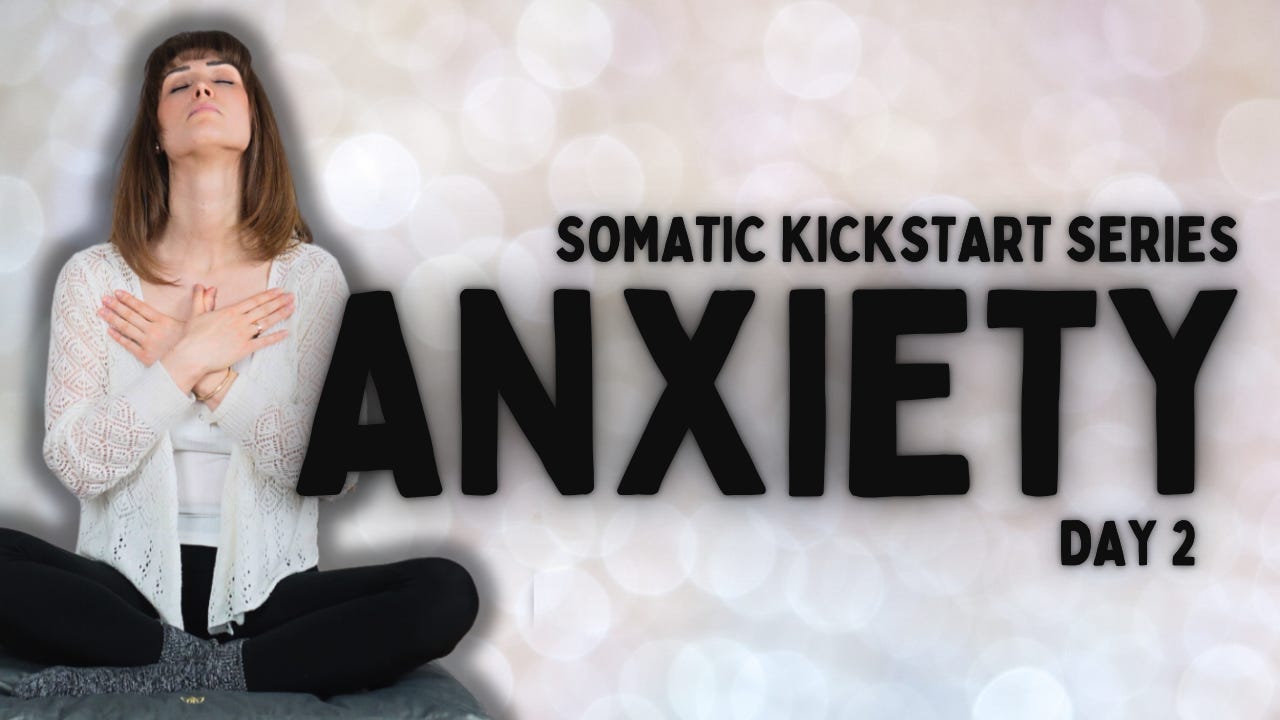
If you’re curious how all of this actually shows up in your body, Day 2 of Somatic Kickstart is up on YouTube. Not as an explanation of anxiety, but as a way to experience how your nervous system responds to rhythm, breath, touch, and pauses in real time.
You don’t need to watch it to understand this article, but you might want to watch it to notice what your body does with it.
-Teresa❤️❤️❤️